When large, hard particles strike a pipeline wall at velocity, ordinary steel pipe wears through fast — and ceramic linings can chip under the same heavy impact. Bimetal wear-resistant pipe is engineered for exactly this service: an outer structural steel tube metallurgically bonded to an inner high-chromium cast iron lining, produced by centrifugal casting in a single operation.
The result is a true composite, not a coating and not a liner slipped inside a tube. The steel outside provides impact toughness, structural strength and weldability; the high-chromium iron inside provides extreme abrasion resistance exactly where the medium contacts the wall. Because the two metals are fused during casting — not glued or bolted — there is no interface that can delaminate or work loose under impact, vibration or thermal cycling.
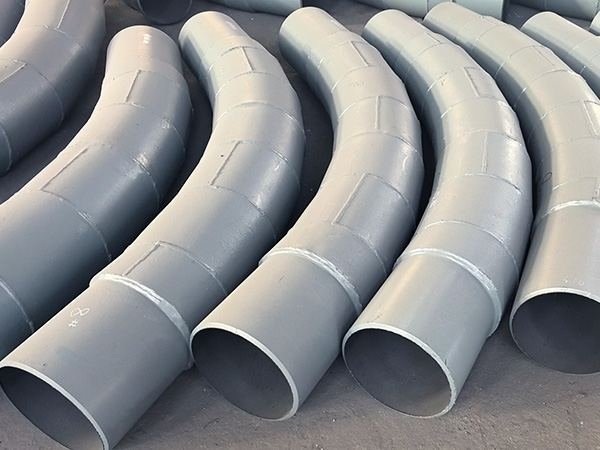
EverWear Pipe (Cangzhou Ruicheng Pipeline Equipment Manufacturing Co., Ltd., founded 2014) manufactures bimetal wear-resistant pipe in its own centrifugal casting workshop in Yanshan Economic Development Zone, Cangzhou, Hebei, China. Straight pipe, elbows, tees and reducers are all produced in the same composite structure, so bends — always the fastest-wearing part of any line — match the straight pipe’s service life.
How Bimetal Composite Pipe Is Made
- Outer tube preparation. A structural carbon steel tube is cleaned, inspected and preheated to the casting temperature.
- Centrifugal casting. Molten high-chromium alloy iron is poured into the rotating outer tube, producing a concentric lining of uniform thickness.
- Metallurgical bonding. As the alloy solidifies, it fuses with the steel substrate at the interface, forming a continuous metallurgical bond.
- Heat treatment. The composite pipe is heat-treated to develop the lining’s hardness and relieve casting stresses.
- Machining and finishing. Ends are faced, and flanges, grooves or weld bevels are machined to your drawing.
Technical Features
- Metallurgical bond, no delamination. The lining is fused to the steel during casting, not inserted afterwards.
- High-chromium iron working layer. Dense chromium-carbide structure for outstanding resistance to cutting and gouging abrasion.
- Steel outside — weldable on site. Simplifies site installation compared with fully ceramic systems.
- Built for heavy impact. Absorbs impact energy where ceramic linings would chip.
- Uniform, concentric lining. Centrifugal casting produces even lining with no thin spots.
- Full fitting range. Elbows, tees, reducers in the identical bimetal composite.
Typical Specifications
| Parameter | Typical range |
|---|---|
| Product name | Bimetal wear-resistant pipe (bimetal composite pipe) |
| Outer tube material | Carbon steel, structural grade |
| Lining material | High-chromium cast iron, centrifugally cast |
| Nominal diameter | DN80 – DN600 typical; larger sizes built to drawing |
| Lining thickness | 8 – 25 mm typical, to drawing |
| Standard pipe length | Up to 6 m typical, to drawing |
| End connections | Flanged, or beveled for butt welding |
| Flange standard | ASME B16.5 / EN 1092-1 / GB / to drawing |
| Working temperature | Up to approx. 350 °C (confirm for your service) |
| Fittings | Elbows, tees, reducers in the same composite structure |
All diameters, lining thicknesses, lengths and end preparations are manufactured to your drawing.
Where Bimetal Wear-Resistant Pipe Is Used
- Mining: coarse ore conveying, crusher discharge lines, tailings lines carrying large particles.
- Metallurgy and steel plants: sinter handling, coke conveying, dedusting ducts.
- Coal preparation: gangue conveying, heavy-medium separation lines.
- Cement: clinker conveying and raw-material lines where lump size rules out brittle linings.
- Dredging and ports: sand, gravel and aggregate lines with high-velocity coarse media.
FAQ
1. Bimetal wear-resistant pipe vs. ceramic lined pipe — how do I choose?
Choose bimetal where particles are large, angular and impact is heavy. Choose ceramic lined where particles are fine and velocity is high.
2. Can bimetal composite pipe be welded on site?
Yes. The outer steel layer welds like conventional carbon steel pipe using standard procedures.
3. Will the lining separate from the steel tube in service?
No. Centrifugal casting creates a true metallurgical bond — one fused structure, not a liner inserted into a tube.
4. Do you supply matching elbows, tees and reducers?
Yes, in the identical composite structure and lining thickness.
5. What information do you need for a quotation?
Nominal diameter, lining thickness, pipe lengths, quantities, and bend/fitting details. A fabrication drawing is ideal.
Request a Quote
Tell us your medium, particle size, pipe diameter and required service life — our engineers will recommend the lining thickness and configuration for your line, and reply within 24 hours.