Cast alloy wear-resistant pipe is a one-piece, centrifugally cast pipe in which the entire wall is a wear-resistant chromium-alloy material. There is no lining and no composite interface: from bore to outer surface, the metal itself resists abrasion.
EverWear Pipe (Cangzhou Ruicheng Pipeline Equipment Manufacturing Co., Ltd., founded 2014) casts, heat-treats and machines alloy wear-resistant pipe in Yanshan Economic Development Zone, Cangzhou, Hebei, China.
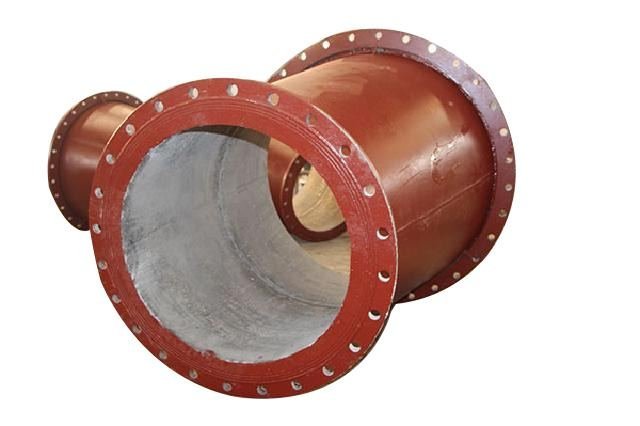
One-Piece Construction: Why It Matters
- Wear is uniform and predictable. Hardness does not change with depth.
- Impact cannot strip the protection. There is no discrete layer to spall off.
- Repairs are straightforward. Worn sections can be built back up by welding.
Technical Features
- Through-wall alloy construction. Complete wall section is wear-resistant chromium alloy.
- Centrifugal casting density. Dense, defect-free wall superior to static-cast equivalents.
- Heat-treated for balance. High surface hardness with toughness for impact and thermal cycling.
- Fully machinable and weldable. Conventional tooling, no special procedures.
- Custom geometries as castings. Elbows, tees, reducers, wyes cast directly in the same alloy.
- Batch-verified quality. Hardness and metallographic structure checked batch by batch.
Typical Specifications
| Parameter | Typical range |
|---|---|
| Product name | Cast alloy wear-resistant pipe |
| Material | Chromium-alloy steel, centrifugal cast, heat-treated |
| Nominal diameter | DN80 – DN600 typical; larger sizes built to drawing |
| Wall thickness | 12 – 45 mm typical, to drawing |
| Standard pipe length | Up to 6 m typical, to drawing |
| End connections | Flanged, or beveled for butt welding |
| Flange standard | ASME B16.5 / EN 1092-1 / GB / to drawing |
| Working temperature | Up to approx. 450 °C (confirm for your service) |
| Fittings | Elbows, tees, reducers, wyes — cast in the same alloy |
Where Cast Alloy Wear-Resistant Pipe Is Used
- Power plants: pulverized-coal lines, ash and slag conveying.
- Mining: medium-abrasion slurry lines, backfill systems.
- Cement: raw meal and kiln feed lines.
- Steel and metallurgy: burden handling, dedusting lines.
- Chemical plants: abrasive slurry service.
FAQ
1. Cast alloy pipe vs. bimetal composite pipe — which lasts longer?
Bimetal generally wins for very large, hard particles. Cast alloy wins on maintainability and uniform wear.
2. Can cast alloy pipe be welded on site?
Yes, with conventional alloy-steel procedures.
3. What wall thicknesses are available?
Typical 12 – 45 mm, heavier walls to drawing.
4. Do you make fittings in the same alloy?
Yes — elbows, tees, reducers, wyes cast in the identical alloy.
5. What do you need for a quotation?
Nominal diameter, wall thickness, lengths, quantities, fitting geometry and flange standard.
Request a Quote
Send us your pipe dimensions, medium and operating temperature — our engineers will confirm the alloy grade, and reply within 24 hours.