Rare-earth alloy wear pipe — known internationally as high-chromium alloy pipe — is a single-metal wear-resistant pipe in which rare-earth elements are added to a chromium-alloy steel melt to refine the grain structure. The result is a pipe wall that is hard and wear-resistant through its full thickness, yet tougher and less brittle than conventional high-chromium cast iron.
EverWear Pipe (Cangzhou Ruicheng Pipeline Equipment Manufacturing Co., Ltd., founded 2014) produces rare-earth alloy wear pipe by centrifugal casting in Yanshan Economic Development Zone, Cangzhou, Hebei, China.
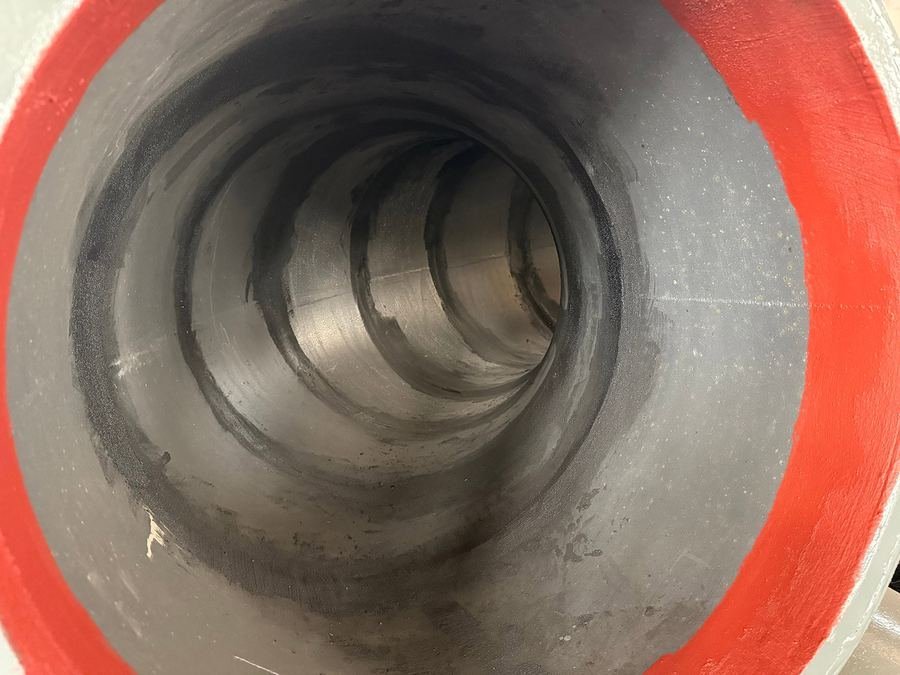
Why Rare-Earth Modification Matters
Adding controlled amounts of rare-earth elements during melting refines the as-cast grain structure. Impact toughness improves, hardness becomes more uniform through the wall, and the refined structure responds better to heat treatment.
Technical Features
- Through-wall wear resistance. The full wall thickness is wear-resistant alloy — no lining to chip or delaminate.
- Rare-earth refined grain structure. Fine, uniform grain balancing hardness with impact toughness.
- Conventional fabrication. Cuts, welds and machines with standard procedures.
- Stable performance at temperature. Maintains properties across temperature swings.
- Predictable wear life. Uniform hardness means steady wear rate.
- Complete fitting program. Elbows, tees, reducers in the same alloy.
Typical Specifications
| Parameter | Typical range |
|---|---|
| Product name | Rare-earth alloy wear pipe (high-chromium alloy pipe) |
| Material | Rare-earth modified chromium-alloy steel, centrifugal cast |
| Nominal diameter | DN80 – DN600 typical; larger sizes built to drawing |
| Wall thickness | 10 – 40 mm typical, to drawing |
| Standard pipe length | Up to 6 m typical, to drawing |
| End connections | Flanged, or beveled for butt welding |
| Flange standard | ASME B16.5 / EN 1092-1 / GB / to drawing |
| Working temperature | Up to approx. 400 °C (confirm for your service) |
| Fittings | Elbows, tees, reducers in the same alloy |
Where Rare-Earth Alloy Wear Pipe Is Used
- Power plants: coal pulverizing systems, fly ash and bottom ash conveying.
- Mining: medium-particle slurry and tailings lines.
- Cement: raw meal, kiln feed and clinker conveying.
- Coal preparation: middlings and refuse lines.
- Chemical plants: abrasive slurry handling.
FAQ
1. What is the difference between “rare-earth alloy” and “high-chromium alloy” pipe?
They describe the same product family. “Rare-earth alloy” is the Chinese industry term; “high-chromium alloy” is the international term.
2. Rare-earth alloy pipe vs. bimetal composite pipe — how do I choose?
Choose rare-earth alloy for medium-particle abrasion with repeated impact and where weldability matters. Choose bimetal for the heaviest large-particle impact.
3. Can it be welded and machined on site?
Yes, with conventional procedures and consumables.
4. How uniform is the hardness through the wall?
Uniform from bore to outer surface, verified by batch hardness testing.
5. What do you need for a quotation?
Nominal diameter, wall thickness, lengths, quantities, fitting details. Include medium and operating temperature.
Request a Quote
Tell us your medium, particle size, operating temperature and pipe dimensions — our engineers will confirm the alloy selection, and reply within 24 hours.